Home/Insights/Industrial leasing in India
Insights · MU·05 Real Estate
Leasing an industrial building or warehouse ties a business to a site for years. The rent matters, but the terms around it, lock-in, escalation, deposit and registration, often matter more.
Industrial leasing is the rental of buildings and land used for manufacturing, storage and distribution: factories, sheds, warehouses, logistics parks and industrial plots. The tenant pays rent for the right to occupy and operate; the landlord keeps ownership and, usually, responsibility for the structure.
In India, demand for industrial and warehouse space has been driven by manufacturing, e-commerce, third-party logistics and automotive occupiers. Most of these tenants want long, predictable leases on modern buildings rather than short agreements on older stock.
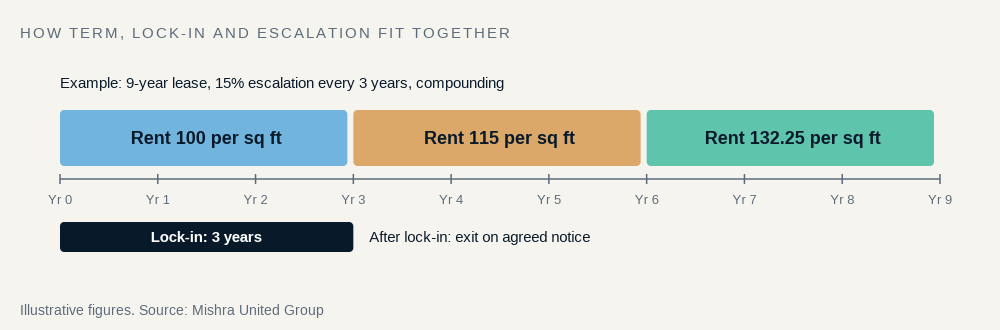
Take a nine-year lease at a starting rent of 100 per square foot per month, with 15% escalation every three years, compounding:
The final rent is 32% above the starting rent, not 30%, because each increase is applied to the already-increased figure. On a large building, that difference is significant, so model the full term before signing.
In India, a lease for a term of more than eleven months generally has to be registered with the local Sub-Registrar, and stamp duty has to be paid on it. An unregistered long lease can be difficult to enforce. This is one reason short agreements are often written for eleven months.
Stamp duty and registration fees are set by each state, and are usually calculated on the rent for the lease term and the security deposit. Commercial rent generally also attracts GST. Because the rules differ from state to state, take local legal advice before signing.
For warehouses and logistics buildings, the specification decides how much the building can actually do. Grade A buildings in India typically offer:
Treat the grade on a brochure as a claim to verify: measure clear height at the lowest obstruction, check floor load certification, and count docks against your actual vehicle movements.
The group’s real estate arm, Twosqft, holds commercial and industrial property for income rather than resale, and keeps leasing, fit-out and asset management in-house. That long-hold approach is why it favours clear, durable lease terms over headline rent.
Questions
The rental of buildings and land used for manufacturing, storage and distribution, such as factories, warehouses, sheds and logistics parks.
Industrial leases commonly run for several years, often between five and ten, usually with a lock-in period at the start.
A period, often around three years for larger leases, during which neither party can end the lease without paying compensation.
Escalation is typically about 15% every three years or about 5% a year, depending on what is negotiated. Check whether increases compound.
A lease for more than eleven months generally has to be registered with the Sub-Registrar and stamp duty paid. Rules and rates vary by state, so take local legal advice.
A modern warehouse built to a high specification, typically with around 10 to 12 metres of clear height, floors rated for about 5 tonnes per square metre or more, dock levellers and proper fire protection.
Related services
More insights
Talk to the group’s real estate desk.
