Home/Insights/Oil and gas travel agency
Insights · MU·03 Mobility
An ordinary business travel agency books trips. An oil and gas travel agency keeps installations manned. Before choosing one, it helps to know exactly what the difference looks like in practice.
Most business travel agencies are built for office travel: a manager flying to a meeting, booked days ahead, travelling in business hours. Oil and gas travel is different. Crews move to fixed rotations, often at short notice, to remote heliports and ports, and a missed connection can leave an installation short-handed.
A specialist travel agency, often called a travel management company, or TMC, is set up around those realities. It plans around the offshore departure rather than the meeting, works through the night when crews are moving, and treats each booking as part of a rotation rather than a one-off trip.
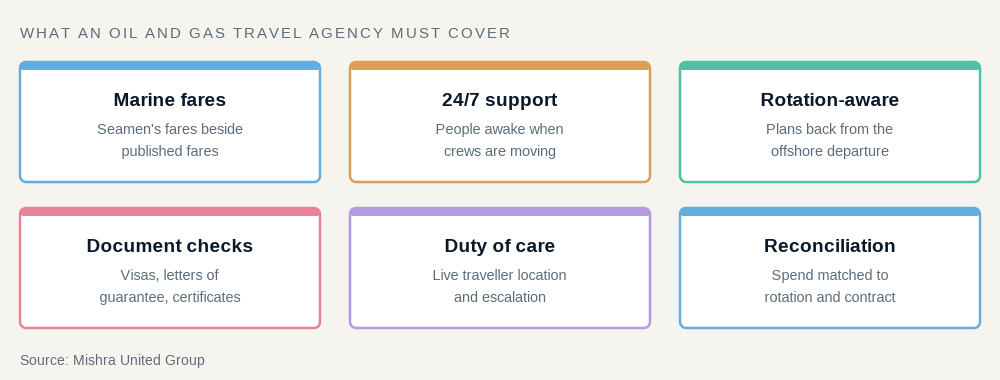
Marine (seamen’s) fares are airline fares for people travelling to or from work on a vessel or installation. They usually allow easier changes and refunds, one-way pricing and a larger baggage allowance. They are generally sold only through agencies with the right airline agreements, so an agency without them cannot offer them at all. A good agency compares marine and published fares on every booking. How marine fares work.
Ask who answers the phone at 3am, and whether they can rebook, not just log a ticket. Crew changes run across time zones, and disruption at night still has to be fixed before the next helicopter or vessel departure.
The agency should plan backwards from the offshore departure, build in weather buffers and hotel nights near the heliport, and plan the outgoing crew together with the incoming one. More on crew rotation logistics.
Visas, transit rules, letters of guarantee and offshore certificates should be checked before booking, not at check-in. The best agencies flag a missing or expiring document while there is still time to fix it.
The operator needs to know where every traveller is and be able to reach them. Look for live itinerary tracking, a clear escalation process for medical, security and weather events, and support with evacuation or repatriation when it is needed.
Crew travel spend is spread across many bookings, changes and refunds. The agency should report spend by rotation, project, vessel, cost centre and contract, and issue invoices that meet local tax rules in each country you operate in, such as GST invoices in India. More on travel programme management.
A policy written for office travel tends to fail offshore. Crew travel needs rules for buffers, hotel nights, marine fares and disruption that reflect manning risk, not just fare cost. More on travel policy.
Travel management companies are commonly paid in one of three ways:
For crew travel, compare agencies on the total cost of moving a crew, fares, changes, hotel nights and the cost of delays, not on the fee per ticket alone.
The group’s Mobility platform was built for operators who move crews, not tourists. It sources marine and published fares in parallel, plans every itinerary against the rotation, and reconciles spend to the contract it belongs to, with a desk that works around the clock.
Questions
A travel management company (TMC) runs an organisation's business travel: booking, changes, traveller support, policy, duty of care and spend reporting, usually under a contract.
Because crew travel is built around rotations, remote heliports and short-notice changes. Specialist agencies offer marine fares, 24/7 rebooking and rotation-aware planning that general agencies usually do not.
No. Marine fares are generally sold only through agencies that hold agreements with the airlines offering them, and travellers must meet each airline's eligibility rules.
Usually through transaction fees per booking or change, a management fee for running the programme, or a combination of the two.
Spend by rotation, project, vessel, cost centre and contract, along with changes, refunds, unused tickets and traveller location for duty of care.
An employer's responsibility to look after travelling staff: knowing where they are, being able to reach them, and supporting them through medical, security or weather emergencies.
Related services
More insights
Talk to the group’s mobility desk.
