Home/Insights/Crew change travel
Insights · MU·03 Mobility
A crew change is not a business trip. It is a fixed point in a rotation that has to happen on time, with the right people holding the right certificates, and when a flight slips, an installation’s manning slips with it.
A crew change is the scheduled swap of personnel on an offshore installation or vessel at the end of a rotation, or hitch. The incoming crew travels out, takes over, and the outgoing crew travels home, often on the same helicopter or vessel.
Rotations vary by operator and region: two weeks on and two weeks off, three and three, or longer patterns such as 28 days on and 28 off. Whatever the pattern, the dates are fixed by the work offshore, not by the airline timetable, and that is what makes crew travel different.
Corporate travel is built around the traveller: comfort, preference, the lowest compliant fare. Crew change travel is built around the rotation. The question is not whether a person reaches a city, but whether the installation or vessel has the right people aboard on the day the hitch starts, and whether the outgoing crew gets home.
That changes almost every decision. The cheapest itinerary that lands the night before a helicopter departure is worse than a dearer one that lands a day earlier, because a missed helicopter can mean a missed hitch, a short-manned shift, or an extended rotation for someone already offshore.
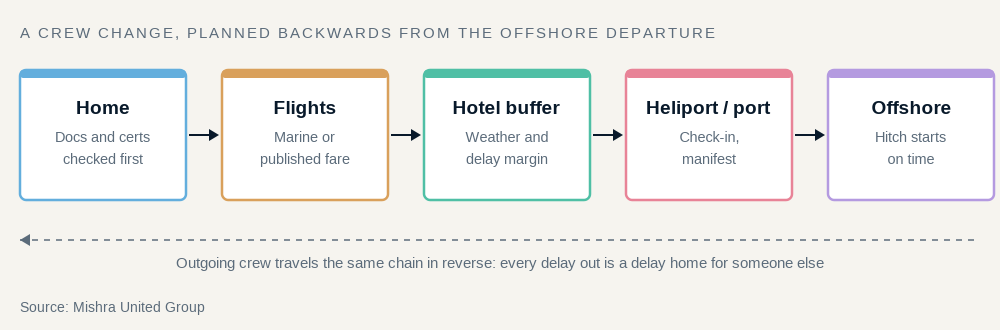
Many full-service airlines publish special fares for seafarers and offshore workers travelling to join or leave a vessel or installation, usually called marine, seamen’s or offshore fares. They are not generally offered by low-cost carriers. Terms vary by airline, but marine fares typically offer:
Marine fares are not always the cheapest option on a given route. A good crew travel desk prices them alongside published fares on every booking and chooses on total cost and risk, not on the fare alone. How the group sources both.
Eligibility is set by each airline, but marine fares are generally for people travelling to or from work on a vessel or offshore installation: seafarers and offshore workers, and often service engineers, surveyors and inspectors attending a vessel. Airlines usually ask for proof such as:
Some airlines add their own conditions, such as enrolment in a corporate programme. Marine fares are normally sold through travel agencies that hold agreements with the airline.
Disruption is the normal state of crew travel, not the exception. Weather holds helicopters, vessels change ports, and one cancelled connection can strand a whole crew. What matters is how quickly the itinerary can be rebuilt, and who is awake to rebuild it. Round-the-clock cover is not a premium extra for crew travel; it is the minimum, because crews move at all hours and across time zones.
An operator needs to know where every traveller is at any moment and be able to reach them, before a disruption turns into a manning problem or a welfare one. That means live itineraries, a single point of contact at any hour, and a clear process for medical, security and weather events.
Crew travel spend is hard to read because it is spread across many short bookings, changes and refunds. The useful measure is not the average fare but the total cost of moving a crew, including changes, extra hotel nights and the cost of delayed rotations. Reconciling every booking to the rotation and the contract it belongs to is what turns that into a number someone can manage. See travel programme management and travel policy.
Questions
The scheduled swap of personnel on an offshore installation or vessel at the end of a rotation, or hitch, when the incoming crew replaces the outgoing crew.
An airline fare for seafarers and offshore workers travelling to join or leave a vessel or installation. Conditions vary by airline but usually include more flexible changes and refunds, one-way pricing and a larger baggage allowance.
Usually people travelling to or from work on a vessel or offshore installation, with supporting documents such as a seafarer's book or a letter of guarantee. Each airline sets its own eligibility rules.
No. They are often good value because of their flexibility and baggage allowance, but on some routes a published fare is cheaper. Each booking should be compared on total cost.
It varies by airline, but 40 kg or two pieces of 23 kg is common. The booking must be correctly coded as a marine fare for the allowance to apply at check-in.
A letter on company letterhead confirming the traveller's reason for travel and vessel details. It also confirms the company takes responsibility for the traveller, including repatriation if entry is refused.
Because crews travel across time zones at all hours, and a disruption at night still has to be fixed before the next helicopter or vessel departure.
Related services
More insights
Talk to the group’s mobility desk.
