Home/Insights/Hydrocarbon accounting
Insights · MU·02 Oil & Gas
Hydrocarbon accounting is the chain that turns what a meter measures into what each partner owns, sells and reports. It sounds like bookkeeping. In practice it is the point where engineering data becomes money.
Hydrocarbon accounting is the set of processes that track oil, gas and water from the point of measurement to the point of sale: measuring produced volumes, allocating them back to the wells and fields they came from, dividing them between the parties entitled to them, and reporting the result to partners, buyers and the regulator.
It is sometimes called production accounting or petroleum accounting, and it sits between two worlds. On one side are engineers, meters and process plants. On the other are commercial teams, joint-venture partners, auditors and tax authorities. Hydrocarbon accounting is the record both sides have to agree on.
The two are related but they start from different places. Oil and gas financial accounting deals in money: revenue, costs, capital spending, depreciation and tax, recorded in the general ledger. Hydrocarbon accounting deals in physical quantities, barrels, cubic metres, tonnes and energy content, and has to show that every one of them is accounted for before anyone can invoice anything.
The output of hydrocarbon accounting becomes the input to financial accounting. Sales volumes drive revenue, entitlement volumes drive each partner’s share, and royalty and tax calculations depend on both. When the physical numbers are wrong, the financial numbers inherit the error.
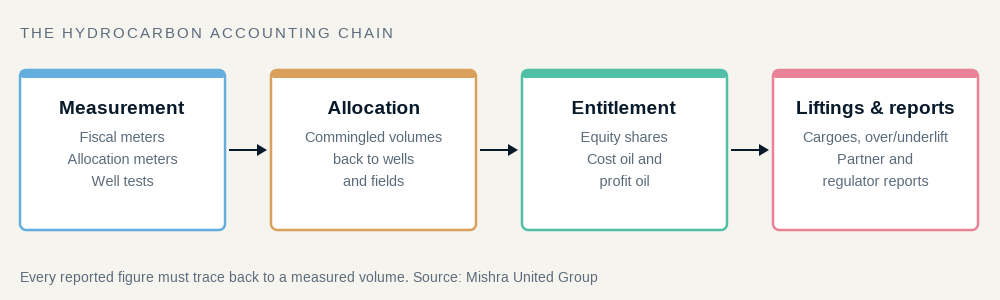
Everything starts at the meter. Fiscal meters at custody-transfer points measure the volumes that change hands between parties, while allocation meters and periodic well tests estimate what each contributing well produced. No meter is exact: each carries an uncertainty, and good hydrocarbon accounting carries that uncertainty forward rather than pretending it is not there. More on fiscal metering.
Most production is commingled. Several wells, and often several fields with different owners, flow through shared pipelines and processing facilities before anything is measured for sale. Allocation divides the measured total back to its sources, usually in proportion to individual measurements or well tests, with adjustments for shrinkage, fuel and losses. The method is written into the agreements between the parties, so allocation is as much a contractual exercise as a technical one. More on production allocation.
Once volumes are allocated to a field, they are split between the parties entitled to them. Joint-venture partners take their equity share. Under a production sharing contract, production is further divided between cost recovery, the contractor’s share of profit oil and the government’s share, according to the contract terms.
Oil is sold by the cargo, not by the barrel. In any period a partner may lift more or less than its entitlement, creating overlift and underlift balances that have to be tracked and settled over time. The period then closes with reports to partners, buyers, auditors and the regulator, and every figure in them has to trace back to a measured volume.
Two fields, A and B, send their oil through a shared pipeline to an export terminal. Field A is owned 60% by Partner X and 40% by Partner Y.
Real allocations are more involved, water cut, gas, condensate, test intervals and contract-specific rules all play a part, but the principle is the same: the sold volume is the anchor, and every share is traced back to it.
None of these is dramatic on its own. Together they produce a familiar month end: days of reconciliation, a variance nobody can fully explain, and a report signed with less confidence than it deserves.
Whether an operator builds or buys, the same tests apply. Good hydrocarbon accounting software should:
A sound process holds the whole chain as one auditable record, from the metering point to the final report. That is the standard the group applies to its own operations. Its oil and gas platform runs hydrocarbon accounting, fiscal metering and production reporting as one measurement chain, on systems built by the group’s own technology arm.
Questions
Largely. Many operators use the two terms interchangeably for the measurement, allocation and reporting of produced volumes. Some use hydrocarbon accounting for the wider chain that also includes entitlement and liftings.
Oil and gas accounting usually means the financial side of an upstream business: revenue, costs, capital spending, royalties and tax. Hydrocarbon accounting supplies the physical volumes that much of it depends on.
Because production from several wells or fields is usually mixed before it is measured at the point of sale. Allocation is the only way to work out how much each source, and therefore each owner, contributed.
Back-allocation works backwards from a measured total, such as an export meter, to the share produced by each contributing well or field, normally in proportion to their individual measurements or well tests.
The difference between what a partner has lifted and sold and what it was entitled to over the same period. The balances are carried forward and settled through later cargoes or cash adjustments.
Operators, joint-venture partners, buyers, auditors, tax authorities and regulators, all of whom depend on the same chain of numbers.
Related services
More insights
Talk to the group’s oil and gas desk.
